Can your computer be creative? National Novel Generation Month 2015

1 Share

Now in its third year, National Novel Generation Month is a whimsical offshoot of the wildly popular National Novel Writing Month. NaNoGenMo participants write a computer program that outputs a “novel” of at least 50,000 words. (There is no official definition of “novel”—any 50,000 words qualify.) The Verge had a good roundup of the 2014 entries.

Last year, I wrote a program that generated a nonsense book inspired by the mysterious 16th century Voynich Manuscript. This year I took inspiration from one of the earliest known works of computer-generated fiction, the little-known SAGA II.

Page

SAGA II was written in 1960 by Douglas T. Ross and Harrison R. Morse at MIT, and was featured in The Thinking Machine, a delightful 1961 CBS television special. In the special (which can be viewed in its entirety online), men in suits sit in comfortable chairs smoking pipes and debating whether computers can be truly creative. What sets the show apart from other examples of breathless futurism is the emphasis on contemporary research—we see actual engineers manipulating room-size computers, light pens, and teletypes.

The SAGA II project was commissioned by the show’s CBS producer, who hypothesized that TV westerns were so stereotyped that a computer could plausibly write a screenplay. In response, the MIT engineers coded a simulation that could generate an infinite number of variations on a classic Western scene: a robber, pursued by a sheriff, breaks into a house, has a few drinks, and engages in a deadly shoot-out. The survivor takes the loot and leaves the scene. CBS filmed two of the computer-generated scripts and, charmingly, one buggy one in which the robber gets stuck in an endless loop, perhaps the earliest form of glitch art.

Here’s what an original script looked like:

(The gun is in the right hand; the money is in the left hand; the glass is on the table; the bottle is on the table; the holster is on the robber; the sheriff’s gun is in the sheriff’s right hand; the sheriff’s holster is on the sheriff.)

ROBBER: (The robber is at the window.) Go to door; open door; go thru door; close door; go to corner; put money down at corner; go to window; put gun down at window; lean on window and look; lean on window and look; go to corner; count money; go to table; pick up glass with right hand (empty); take glass from right hand with left hand; pick up bottle with right hand; pour; put bottle on table; take glass from left hand with right hand; take a drink from glass; put glass on table; pick up bottle with right hand; pour; go to corner; put bottle down at corner; go to window; pick up gun with right hand; check gun; put gun in holster; go to table; pick up glass with right hand; take a drink from glass; go to window; put glass down at window.

SHERIFF: (The sheriff is at the window.) See robber; (robber sees sheriff); go to door.

ROBBER: Take gun from holster with right hand; check gun; go to door; check gun; put gun down at door.

SHERIFF: Open door; see robber; (robber sees sheriff); go thru door; go to window.

ROBBER: Pick up gun with right hand.

SHERIFF: Go to table.

ROBBER: Aim; fire; MISSED; aim; fire; SHERIFF HIT; blow out barrel; put gun in holster.

SHERIFF: Drop gun; sheriff dies.

ROBBER: Go to corner; pick up money with right hand; go to door; go thru door; close door. CURTAIN.

The remake

The source code for SAGA II is long gone, but enough artifacts remained that I felt confident I could write a reasonable fascimile. I had three primary sources:

  1. The Thinking Machine special itself, which includes logical storyboards from the project.
  2. An original 1960 memo describing the technical implementation of the switching and branching system.
  3. Safari! To my delight, the best reference turned out to be Donald Knuth’s Art of Computer Programming, Volume 2, which includes two example scripts: sheriff wins and robber wins. I was able to infer a lot about the world model from these transcripts.
loop-detail

I chose to write my implementation in modern Python rather than imitating the original’s global variables and weighted probabilities. That said, I still had to write a lot of code; there’s a surprising amount of hidden logic in the original, including objects which can contain or support other objects, a model of handedness, and the quantity of whisky and bullets remaining in the actors’ inventory. In the end I arrived at a weird hybrid of interactive fiction, role-playing games (each ‘actor’ rolls for initiative based on their current state), an event queue, and the kind of object-oriented code you normally only write in computer science class (“a Robber is a type of Person that is a type of Thing”). And since I had to satisfy the one rule of NaNoGenMo, I made the program generate 350 unique scenes for a total of 53,392 words.

The most important code in the simulation: shooting.

def shoot(self, target, aimed=False):
        """Shoot first, ask questions never"""
        gun = self.get_if_held(Gun)
        if gun:
            # Usually we'll aim and then fire, sometimes we'll just fire
            if not aimed:
                if random.randint(0, 5) > 1:
                    print("aim")
                    self.queue.append((self.shoot, target, True))
                    return False
            print("fire")
            log.debug("%s is trying to shoot %s", self.name, target.name)

            # Establish any weighting factors based on the type of person that affects
            # their accuracy (e.g. the Robber is more accurate when he's drunk)
            hit_weight = self.starting_hit_weight()

            # As in the original, the actors get inexplicably more accurate if they're on their 
            # last bullet
            if gun.num_bullets == 1:
                hit_weight += 1

            # Also defying common sense, they get more accurate if they're injured
            if self.health < DEFAULT_HEALTH:
                hit_weight += 1

            weighted_hit_or_miss = [('miss', 3), ('nick', 3 * hit_weight), ('hit', 1 * hit_weight)]
            hit_or_nick = random.choice([val for val, cnt in weighted_hit_or_miss for i in range(cnt)])
            # Print the relevant 'HIT' or 'MISS' message based on the outcome...
            print(GUN_DAMAGE[hit_or_nick]['message'].format(target.name))

            # ...and update the target's health based on that outcome
            target.health += GUN_DAMAGE[hit_or_nick]['health']
            gun.num_bullets -= 1
            return True

(I asked my husband to proofread this post and he noted that the code never checks if there are bullets remaining. PATCHES WELCOME.)

Example teleplay

The gun is in the robber’s right hand. The money is in the robber’s
left hand. The holster is on the robber. The sheriff’s gun is in the
sheriff’s right hand. The sheriff’s holster is on the sheriff. The
glass is on the table. The bottle is on the table.

ROBBER:  (The robber is at the window.) Open door; go through door;
close door; go to corner; put money on corner; go to table; go to
window; check gun; go to corner; go to table; pick up the glass with
the robber’s left hand; go to window; go to corner; count money

SHERIFF: Go to window; open door; go through door

ROBBER: Fire; sheriff NICKED

SHERIFF: Close door; aim

ROBBER: Fire; MISSED

SHERIFF: Fire; MISSED

ROBBER: Fire; sheriff NICKED

SHERIFF: Aim; fire; robber NICKED

ROBBER: Aim; fire; sheriff HIT; aim; fire; sheriff NICKED

SHERIFF: Sheriff dies.

ROBBER: Blow out barrel; put gun in holster; pick up the money with the
robber’s right hand; go to table; open door; go through door; close
door

CURTAIN

Source code and complete NaNoGenMo “novel” are on Github.

For fun I also tried a variant where I spawned dozens of robbers and sheriffs who all wanted to kill each other:

GREEN ROBBER: close door; go to corner

NAVY ROBBER: aim

OCHRE SHERIFF: close door

NAVY ROBBER: fire; MISSED; fire; navy sheriff NICKED; aim

NAVY SHERIFF: close door; aim

GREEN SHERIFF: close door

RED ROBBER: aim

GRAY ROBBER: aim

NAVY ROBBER: fire; navy sheriff NICKED; navy sheriff HIT

NAVY SHERIFF: navy sheriff dies.

…but I think to make more compelling I’d need to introduce some interactions that weren’t present in the original.

Write your own program to write its own novel

National Novel Generation Month runs through the end of November (but since it’s not a real contest anyway, anyone can participate any time). Inspiration can be found in the list of projects that are completed or in-progress for 2015.

Read the whole story
rosskarchner
3800 days ago
reply
Share this story
Delete

Cyber-rattling from a weak, equivocal, and ignorant Donald Trump

1 Share

Donald Trump’s interview about technology on breitbart.com is uncharacteristically equivocal; he sounds like any other politician. Apparently, his batshit candor is limited to tweets, debates, and speeches. Memo to Trump-haters and opponents: technology is his weak spot. Breitbart Tech’s Milo Yiannopolous interviewed Trump about tech issues from the NSA to artificial intelligence. Full of equivocation and hedges, Trump’s … Continue reading Cyber-rattling from a weak, equivocal, and ignorant Donald Trump

The post Cyber-rattling from a weak, equivocal, and ignorant Donald Trump appeared first on without bullshit.

Read the whole story
rosskarchner
3800 days ago
reply
Share this story
Delete

5 Big Takeaways From Danny Meyer’s No-Tipping Town Hall Meeting

1 Comment and 2 Shares

Danny Meyer, Erin Moran, Sabato Sagaria, and Abram Bissell.

Last night at the Martha Washington Hotel, Danny Meyer’s Union Square Hospitality Group hosted its first "Hospitality Included" town hall, a meeting intended to explain the company's decision to eliminate tipping ("Hospitality Included" is the company's name for the new policy), answer questions, and address concerns from the public. The event featured a panel of four USHG members: Meyer, the Modern executive chef Abram Bissell (whose restaurant will be the first to adopt the new policy), chief cultural officer Erin Moran, and chief restaurant officer Sabato Sagaria. It’s been less than three weeks since the world learned of the shift, and given the scope and influence of Meyer’s restaurant group, it’s one of the bigger dining stories of the year. Here are five takeaways from last night’s question-and-answer session:

1. The policy's effects are already being felt at the Modern. The policy change won’t take place until later this month, and even then, it will be on a two-month trial period. But cooks are responding. According to Bissell, the kitchen was “in a crisis” about three months ago because it was short 12 cooks. They were getting just two to three applications per month, but since the announcement, he says, that number has jumped to two or three applications a day.

2. Meyer says wage inequality between cook and front-of-house staffers is worse than ever. Things have gotten so bad, Meyer says, that, “for the first time in my entire career, we have a restaurant, North End Grill, that has more Culinary Institute of America graduates working in the dining room than in the kitchen.” The reason why is simple: If you love restaurants, Meyer says, “but the only way you can afford to live in this city is to serve food rather than cook, you don’t have the luxury of making a choice.”

3. Customers' overall check averages will have to rise to offset added expenses.
As one audience member pointed out, customers' final bills are expected to be 5 to 8 percent higher than they are now. One audience member pointed out that inflation is flat, so customers will just be paying more money for the same meal. As Sagaria explained, this is because the amount left for a tip isn't taxed, but the additional revenue from the Hospitality Included model will be, so the added cost will cover that expense.

4. Without tips, how will customers be able to indicate how happy they are with the service? “The same way you give feedback if we overcook your salmon,” Meyer says, who outright dismissed the idea, and the effectiveness, of tipping as "punishment" for poor service. When prices include service and hospitality, he says, “our job is to make it right” — or take that item off the bill. In addition to that, Meyer, who bills Hospitality Included as a merit-based system, has talked about implementing a user-feedback rating system that, he argues, will allow USHG to “get much better data from you than we ever got or get with respect to your tips.”

5. Raising cooks' wages is the only way to ensure great restaurants will survive. With Shake Shack, Meyer may have created the fast-casual chain that chefs around the world want to emulate, but, he says, “I don’t want that to be the only way I can go out to dine in New York City, as a consumer or restaurateur.” In his eyes, this move is necessary to maintain a strong workforce in the kitchen. Otherwise, wage inequity “is going to completely dry up the influx of the kind of culinary talent we need to run great restaurants.”

Read more posts by Chris Crowley

Filed Under: explanations, danny meyer, new york city, news, takeaways, tipping, union square hospitality group

Read the whole story
rosskarchner
3801 days ago
reply
Share this story
Delete
1 public comment
cinebot
3801 days ago
reply
"Meyer says, that, “for the first time in my entire career, we have a restaurant, North End Grill, that has more Culinary Institute of America graduates working in the dining room than in the kitchen.” The reason why is simple: If you love restaurants, Meyer says, “but the only way you can afford to live in this city is to serve food rather than cook, you don’t have the luxury of making a choice.”"
toronto.
digdoug
3800 days ago
I really hope this catches on everywhere.

A Lot of What We Think We Know About World War II Is Wrong

2 Shares
The Second World War remains an enduringly fascinating subject, but despite the large number of films, documentaries, books and even comics on the subject, our understanding of this catastrophic conflict, even seven decades on, remains heavily dependent on conventional wisdom, propaganda and an interpretation skewed by the information available. In...


Read the whole story
rosskarchner
3804 days ago
reply
Share this story
Delete

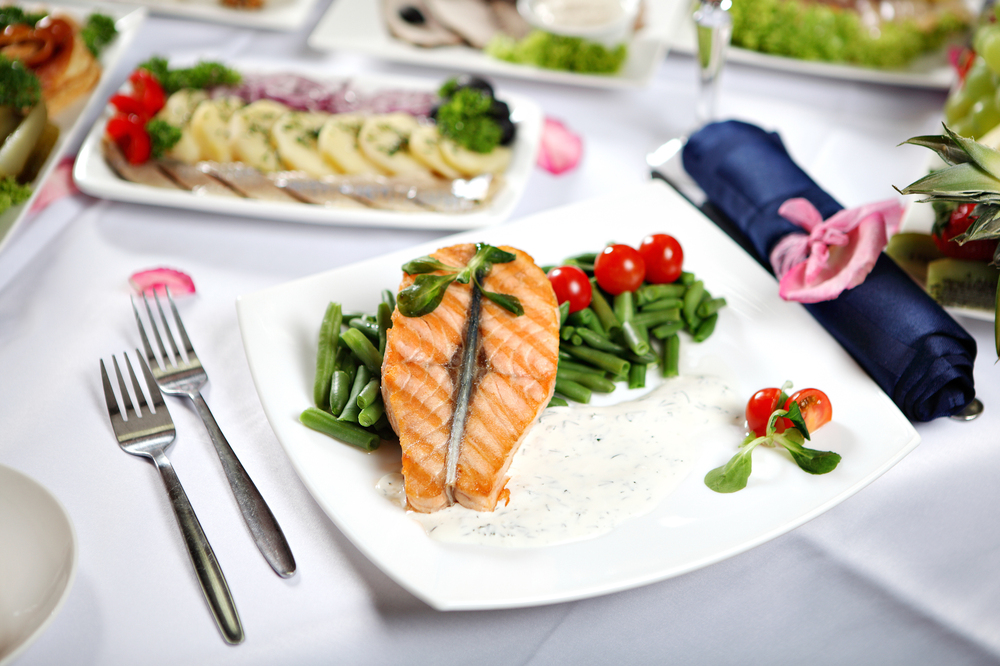
That Salmon On The Menu Might Be A Fraud — Especially In Winter

2 Shares
When salmon was out of season, diners in restaurants were likely to get a species other than what they ordered 67 percent of the time, a new survey finds.

When salmon was out of season, diners in restaurants were likely to get a species other than what they ordered 67 percent of the time, a new survey finds.

iStockphoto

Would you be able to tell if the wild Alaskan sockeye salmon you ordered for dinner was swapped out for a less expensive piece of farm-raised salmon?

For the observant, the color difference between the two would likely be the first giveaway. give away. (Sockeye has a deeper red-orange hue.) Or maybe you'd notice the disparity in the thickness of fillet. (Sockeye is flatter and less steaky in appearance.)

But what if you ordered the most coveted of salmon species — king salmon? (It's also known as chinook.) Chinook.) Much like farmed Atlantic salmon, it's light in color, thick in texture and similarly marbled with fat. It's also significantly more expensive. And according toa new report released Wednesday by conservation group Oceana, it's a fish about which where you're more likely to get duped — especially if you order it from a restaurant during the winter.

In its latest attempt to uncover seafood fraud, Oceana collected and tested 82 salmon samples from restaurants and grocery stores in Virginia; Washington, D.C.; Chicago, Virginia, Washington, D.C., Chicago and New York between December 2013 and March 2014. Results showed that 43 percent of salmon samples tested were mislabeled, and that far more of that mislabeling is occurring in restaurants than in large supermarkets.

The instances of salmon fraud were significantly higher than during anearlier 2013 nationwide study by the same group. That study included far more — 384 samples, which showed salmon fraud at only 7 percent. But the jump isn't being attributed to a sudden increase in unabandoned label swapping, rampant menu high jinks hijinks or differences in sample size. This survey was designed to measure fraud during the winter months, when salmon was not in season season, and the marketplace would be shorter on supply, says Kimberly Warner, a senior scientist at Oceana who authored the new report.

"In D.C. in summer, I don't think we had any salmon mislabeling. Same for Chicago," Warner tells The Salt.

To select samples for the newest study, Oceana searched online menus for restaurants touting "wild salmon" and sought out salmon labeled "wild" in grocery stores.

What the group found was that when wild salmon was out of season, the testing netted significantly different results. Diners were likely to get duped 67 percent of the time when ordering salmon in restaurants, compared with 20 percent of the time when buying in large grocery stores — which have to comply with country of origin labeling (COOL) regulations. And when diners were deceived, it was more likely to be an incident of farmed salmon being passed off as more expensive wild (69 percent of the time).

Erica Cline, an associate professor at the University of Washington, Washington Tacoma, conducted asimilar study published in 2012. Initially, she also found higher rates of farmed salmon being swapped for wild during winter months. But her ongoing testing in the years since has found that fraud tends to fluctuate regardless of season. Like Oceana's report, "we still see substantially higher rates of substitution in restaurants than in [grocery] stores," Cline says.

Oceana says this kind of fraud is a real economic problem: Salmon-loving consumers aren't always getting what they're paying for, and responsible American salmon fishermen, fishermen are being forced to compete with fraudulent products, are products "receiving less cash than they should be for their hard-won catch," according to the report.

And Warner says it's also an environmental problem for those consumers who go the extra mile to consult seafood sustainability ratings like the Monterey Bay Aquarium's Seafood Watch, which ranks seafood as "best choice," "good alternative" or "avoid."

Salmon for sale at a market.

Salmon for sale at a market.

Joe Mable/Wikimedia

"If someone is trying to purchase something rated as a 'best choice,' "best choice," like a wild Alaskan salmon, and is getting in its place something from a foreign country that has problems with sea lice or antibiotic use — if farmed — or was caught illegally, it could have serious ecological consequences," says Warner.

"Serious ecological consequences" is strong language. If the marketplace swap is simply farmed salmon for wild, rather than a species threatened by overfishing, the damage to the environment may be less than the damage to a deceived diner's wallet. After all, the farmed-salmon Afterall, the farmed salmon industry has come a long way from its it's days as a poster child for bad aquaculture practices. practices, says NOAA Fisheries spokesperson Jennie Lyons.

"There are a lot of misconceptions about aquaculture, and farmed salmon," NOAA Fisheries spokeswoman Jennie Lyons tells The Salt.

Salmon is the most popular fish in America. We consume impressive amounts of it — nearly 870 million pounds of a year. The majority of that, nearly two-thirds, comes come from farmed salmon, grown outside the U.S, despite the fact that American fishermen catch enough salmon to satisfy 80 percent of our domestic demand.

But global seafood supply chains are complex. Fish don't often travel in a straight line from fishermen to chef to plate. Approximately 70 percent of U.S. wild-caught salmon is exported, much of it to Asia for processing into tidy fillets. And at each step in that journey, information about the fish — where it was caught, how it was caught and the exact species — can get left behind. That's true even when the same salmon sent to China for processing is refrozen and shipped back to to the U.S. us — a head-scratching fish swap noted by authorPaul Greenberg in his book American Catch.

Precisely how much of that salmon comes back to quell American appetites is unclear.

"No one has yet given me a satisfying answer for how much of that is re-imported," reimported," says Greenberg.

Warner says that's because no one is tracking it. This system creates conditions ripe for fraud and mislabeling. There are no traceability requirements in place that will follow a fish from the point where it was caught to its final place on your dinner plate.

"We have no tracking of our fish through the supply chain. That's how something like illegally illegal caught Russian salmon can enter into our supply chain," she says — and be mislabeled as "Pacific "pacific salmon" or "wild salmon."

And it is why Oceana is calling on thePresident's Task Force on Combating Illegal, Unreported and Unregulated Fishing and Seafood Fraud to include salmon as a species asaspecies at high risk for fraud fraud, and to expand documentation requirements to all seafood entering the U.S. supply chain.

Steven Wilson, deputy director of the Office of International Affairs andSeafood Inspection at NOAA Fisheries, is a member of the task force. He He, says issues of seafood fraud are on the government's radar but that radar, but says NOAA's own testing has not shown an uptick in salmon species substitutions.

"We're seeing an increase of seafood fraud as you move further down the supply chain, but we're not seeing an increase in the overall percentage being mislabeled," says Wilson. The further down the supply chain a fish goes, the likelier it is to be mislabeled he says — but he stresses that not all menu mislabeling is intentional.

"Someone can make a simple mistake," Wilson says. "They serve salmon on the menu, run out, buy more and wouldn't necessarily even think about it. It's very telling that salmon fraud identified in grocery stores was far less. Restaurants are the most susceptible."

His advice on avoiding salmon fraud echoes Oceana's: Ask questions — and lots of them. Look at the price you're paying for the salmon: If it's too good to be true, be cautious. Warner would add: Seek out Seek-out wild salmon in-season, and look for fish that are traceable back to the boat.

Wilson says it's important to keep the problem in perspective.

"Is the consumer being defrauded? If the consumer definitely wants wild caught, they're not getting what they're paying for," he says. "But what if they're paying less? If they're paying for Atlantic salmon, they're getting what they're paying for. What if they're paying for ambiance, a night out with good friends? [Then] they're getting what they're paying for. It's fuzzy. I'm not condoning it, but how far do we go, and what's the punishment?"

Copyright 2015 NPR. To see more, visit http://www.npr.org/.
Read the whole story
rosskarchner
3806 days ago
reply
Share this story
Delete

8 questions about the Senate's Byrd Rule you were too embarrassed to ask

1 Comment

On Friday, the House of Representatives passed a budget reconciliation bill repealing key segments of Obamacare and prohibiting the payment of any federal funds to Planned Parenthood. The primary purpose of this bill is to set up a confrontation with President Obama. This bill next moves to the Senate, where several of its key provisions will likely be killed by the Byrd Rule.

1) What is budget reconciliation?

The 1974 Budget Act (as updated) requires* Congress to come up with a spending plan, or "budget resolution," every year. A budget resolution might instruct multiple House and Senate policy committees to report bills to reconcile current law with the budget plan. A budget reconciliation bill bundles these statutory changes together.

The critical feature of budget reconciliation bills for this post is that they cannot be filibustered in the Senate. So if the Senate majority party has a tax or spending proposal it really wants to pass, the budget reconciliation process may be its best option.

2) What if the Senate majority really wants to pass something that doesn't affect the budget? Can it use the budget reconciliation process?

This brings us to the Byrd Rule. The Byrd Rule is a section of the budget law that prevents non-budgetary policy proposals from being slipped into a "budget" bill or offered as an amendment on the Senate floor. Any senator can raise a point of order against a provision or amendment that violates the Byrd Rule, and it takes 60 votes to waive the Byrd Rule.

In simpler terms: The Byrd Rule prevents senators from trying to get their favorite policies past the 60-vote threshold they would normally need to get past a filibuster.

3) How does the Byrd Rule affect the Republican bill?

A quick read of the House bill (H.R. 3762) suggests that at least two sections are vulnerable:

  1. A repeal of an Obamacare mandate that employers provide health insurance for their employees. The Congressional Budget Office estimates that this provision will increase the number of uninsured by 675,000 and lead to higher tax revenues, assuming that employers pay higher wages instead of providing health care insurance.
  2. A provision defunding Planned Parenthood. Republicans could get past the Byrd Rule if they simply banned any spending on women's health, but that would be political suicide. But if the GOP proposal is to spend the same funds using different health care providers, that's policy-related, not budgetary. Dinged.

Notably, the CBO estimate makes clear that the House bill recently dropped a provision to eliminate the Independent Payment Advisory Board, which the Senate parliamentarian had already singled out as vulnerable to the Byrd Rule. The CBO report states that this provision would not affect the budget until 2022, at which point eliminating the IPAD means forgoing the $7.1 billion it would save from 2022 to 2025.

4) Oh, that makes me so mad/glad! Why does the Byrd rule exist?

The 1974 budget process was only intended to provide an end run around the Senate filibuster for essential budget policy decisions. Senators never intended to create the loophole that ate the rule.

But as this Congressional Research Service report points out, Senate committees soon began including extraneous policy provisions in their "budget" legislation. This came to a head in 1985, when the Senate, led by then-Minority Leader Robert Byrd (D-WV), amended the budget process to apply the restrictions applied above. Byrd's amendment was adopted 96-0.** The rationale for the rule, both then and now, was 1) to protect reconciliation bills from being bogged down by controversial policy riders, and 2) to protect the Senate filibuster.

5) Wait, senators deliberately protected filibustering?

Unanimously. The "budget reconciliation" loophole could have been used to exempt the majority party's agenda from obstruction by declaring each part of the agenda a "reconciliation" bill. Realizing this, senators plugged the leak ASAP.

The broader point is that the filibuster has persisted in the Senate to this point because, at some level, senators know they can get rid of it and choose not to do so. The filibuster is not an accident of history; it is a choice.

6) Can Senate Republicans save the bill by firing the Senate parliamentarian?

As suggested by Ted Cruz? It is true that the parliamentarian makes initial recommendations regarding the application of the Byrd Rule, and can be fired. But the parliamentarian's role is to provide advice to the Senate's presiding officer: Joe Biden. Like most modern vice presidents, Biden does not act as the Senate's traffic cop on a daily basis, but on critical days — say, consideration of a budget reconciliation bill — he could show up and issue critical rulings on the application of the Byrd Rule, disregarding a newly installed and 100 percent Republican party-hack parliamentarian as he sees fit. It is not clear that firing the parliamentarian would solve the Republicans' problem.

7) Can Senate Republicans just repeal the Byrd Rule?

No. The Byrd Rule is part of a law, not the rules of the Senate. If the Republicans wanted to "go nuclear," they could bring up their policy items as a separate bill and then use a "nuclear option" approach to impose majority cloture on legislation ... but that seems unlikely.

8) How will I be affected if the Republicans win (or lose)?

In the short run, not at all. This is the most fascinating part to me: The Republicans know this bill will never become law. It will be vetoed, and the veto will be sustained. This fight is really about exactly which provisions are in the bill when it fails.

Behind this windmill tilting is an illuminating view of the goals of current Republican lawmakers politicians. They invest great effort — even reshaping their institutions — not in changing public policy but in staging political confrontations.

And some Republican senators have already declared that they won't vote for the budget reconciliation bill anyway, because it doesn't contain some of the provisions of Obamacare that they would like to pretend to repeal. As provisions of the bill fall victim to the Byrd Rule, it is possible that more senators will be disappointed that this bill-that-will-never-be-law does not contain more provisions-that-never-had-a-chance, and the bill will fail to pass the Senate.

* "Requires" — it's not like legislators will actually be thrown in jail or defeated for reelection if they don't come up with a budget resolution. This year is the first time since 2009 that both chambers have agreed on a budget resolution.

** I'm skipping over some boring details that are laid out in the CRS report. The Byrd Rule was adopted in stages over a six-year period.

This post is part of Mischiefs of Faction, an independent political science blog featuring reflections on the party system. See more Mischiefs of Faction posts here.

Read the whole story
rosskarchner
3807 days ago
reply
"They invest great effort — even reshaping their institutions — not in changing public policy but in staging political confrontations."
Share this story
Delete
Next Page of Stories